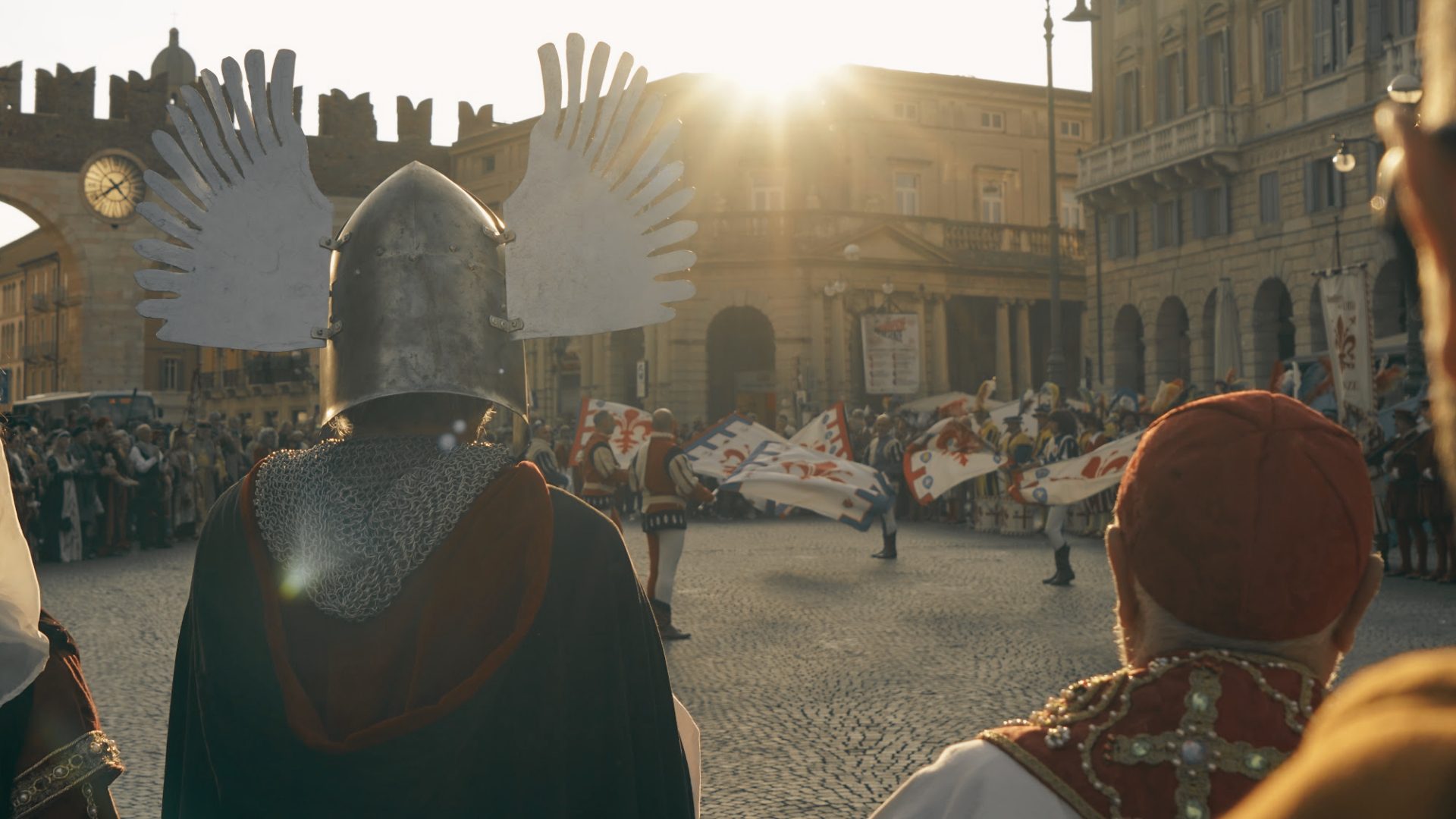

The deep rumble of drums across the crenellated bridge of Castelvecchio was not a distant echo from seven centuries ago, but the living heartbeat of a city that echoed through the stones of the Arsenal all the way to the heart of Piazza dei Signori. At the end of October each year, photos and videos of the historical procession make the rounds on social media: gleaming armor, heavy velvets, banners unfurled in the wind. Yet behind the visual impact of a successful historical reenactment lies a crucial node in Veronese history—a turning point that transformed a river city into the capital of one of the most enlightened lordships of the European Middle Ages.
What played out before us is the memory of 1308: the year that marked the wedding between a very young Cangrande I della Scala and Giovanna of Antioch.
Love at first sight and a detour of destiny
In 1308, seventeen-year-old Cangrande was not yet the sole and feared ruler of the Veronese March, but shared power with his brother Alboino. Giovanna, for her part, carried the imperial blood of the Hohenstaufen dynasty in her veins: she was the daughter of Conrad of Antioch and the direct great-granddaughter of Emperor Frederick II of Hohenstaufen.
History tells us that Giovanna was never supposed to stop in Verona. She was traveling toward German lands to marry an elderly local nobleman entirely unknown to her. The Scaliger stopover was intended only as a brief family pause while staying with her sister Constance, wife of the then-late Bartolomeo I della Scala.
That was when the unexpected happened: love at first sight between the young Cangrande and the Swabian princess upended every pre-arranged diplomatic agreement. The journey northward came to an end forever, and Verona celebrated a wedding that inextricably bound the House of Della Scala to the Swabian imperial heritage.
It was a lasting, solid union deeply entwined with the city’s political affairs for over twenty years. No legitimate heirs were born from the marriage: upon the lord’s sudden death in Treviso in 1329, the succession passed to his nephews Mastino II and Alberto II, while Giovanna continued to live in Verona and preserve the memory of the lordship until her passing in 1352.
The Flags of Florence and the Shadow of the Supreme Poet
Anyone who witnessed the procession or saw snippets of it in our reel surely noticed a striking scenic and historical detail: the presence of the Florentine flag bearers and the historical cortege of the Calcio Storico from the Republic of Florence.
Seeing the lilies of Florence pay homage to the emblems of the ladder in Piazza dei Signori is not mere virtuosity between historical groups. It represents the living memory of the cultural debt Florence owes to Verona. It was right among these palaces that Dante Alighieri, exiled and hunted by his own homeland, found his “first refuge and first lodging,” guaranteed first by Bartolomeo and later transformed into absolute patronage under the court of Cangrande—to whom the Supreme Poet would dedicate the Paradise a protection that the Scaliger family would also extend to his children.
The reenactment curated by the Amici del Teatro association and directed by Alessandro Bravi reconnected this subtle thread: the departure from the Scaliger bridge of Castelvecchio, the stop for the flag performance in Piazza Bra, the passage beneath the Portoni Borsari, and the solemn tribute beside Cangrande’s Ark have once again placed the deepest meaning of that pact between cities at the center.
Walking through history, stone by stone
Historic cities are not open-air museums frozen in time. They are layered narratives that continue to live on through the places, architectures, and stories of the people who inhabit them. They are simply waiting to be explored at the right pace, step by step.
Tracing the axis today that leads from the Adige River to Piazza dei Signori through the Scaliger Tombs means reading the signs carved into the marble, recognizing heraldic symbols like the dog and the ladder, and observing the architecture that tells the story of the city’s power and history.
Yet, Verona’s history does not end with its monuments. It continues to thrive in traditional dishes, historic artisan shops, bustling piazza markets, and glasses of local wine that speak of the surrounding land. All of these are expressions of an identity forged over time—profound traces left behind also by Dante and the Scaliger court.
Watching the historical procession march by felt like a dive back into 1308; exploring the city every day means realizing that this history has never stopped speaking to us.